The residential code sentence
UpCodes displays the 2023 Florida Building Code, Residential, 8th edition. Section R404.4, as read there on November 1, 2026, says retaining walls that are not laterally supported at the top and that retain in excess of 48 inches (1219 mm) of unbalanced fill, or retaining walls exceeding 24 inches (610 mm) in height that resist lateral loads in addition to soil, shall be designed in accordance with accepted engineering practice to ensure stability against overturning, sliding, excessive foundation pressure, and water uplift. The next sentence sets a safety factor of 1.5 against lateral sliding and overturning. The last sentence says this section shall not apply to foundation walls supporting buildings.
Unbalanced fill is the soil on the high side that the wall is holding. A low garden wall with the same grade on both sides is not that case. A seat wall around a patio that people sit on, and that does not retain a bank, is a different project from a wall cut into a slope. The 24-inch sentence is the one that matters when something besides soil pushes on the wall. A driveway, a slope surcharge, or a pool above the wall can be that extra lateral load. The code uses the words 'lateral loads in addition to soil.' It does not list driveways by name. Ask an engineer if a paved load sits on the high side rather than deciding the 48-inch sentence is the only trigger.
| Situation in the section | What the section requires | What it does not say |
|---|---|---|
| No top support, more than 48 inches of unbalanced fill | Engineering for overturning, sliding, foundation pressure, and water uplift | It does not say a shorter wall is automatically permit-exempt |
| Taller than 24 inches and resisting extra lateral load | The same engineering duty | It does not name driveways, but extra load is the test |
| Safety factor | 1.5 against sliding and overturning | It does not set a construction price |
| Foundation walls that support a building | This section does not apply | Those walls use the foundation-wall sections instead |
Permit versus engineering
Engineering and a building permit are related and not identical. R404.4 tells you when a design is required. Whether a shorter wall still needs a permit application is an administrative question, in the building code's permit chapter and in the local amendment. The training PDF's 4-foot exemption is the sentence people repeat. Because we could not match it to an 8th-edition page we are willing to treat as current, this guide will not say 'under 4 feet, no permit in Volusia.' A search of the county building pages on November 1, 2026 did not turn up a Volusia retaining-wall checklist with its own height. Absence of a webpage is not proof that no permit is required.
Orange County, Florida, which is not Volusia, quotes R404.4 on a residential plan checklist and asks for signed and sealed engineering. That is evidence the section is in active use in the state. It is not evidence that Orange County's paperwork is accepted in DeLand or Daytona Beach. Do not drive an out-of-county checklist to a Volusia counter and expect it to be the local form.
Seat walls, fire pits, and drainage
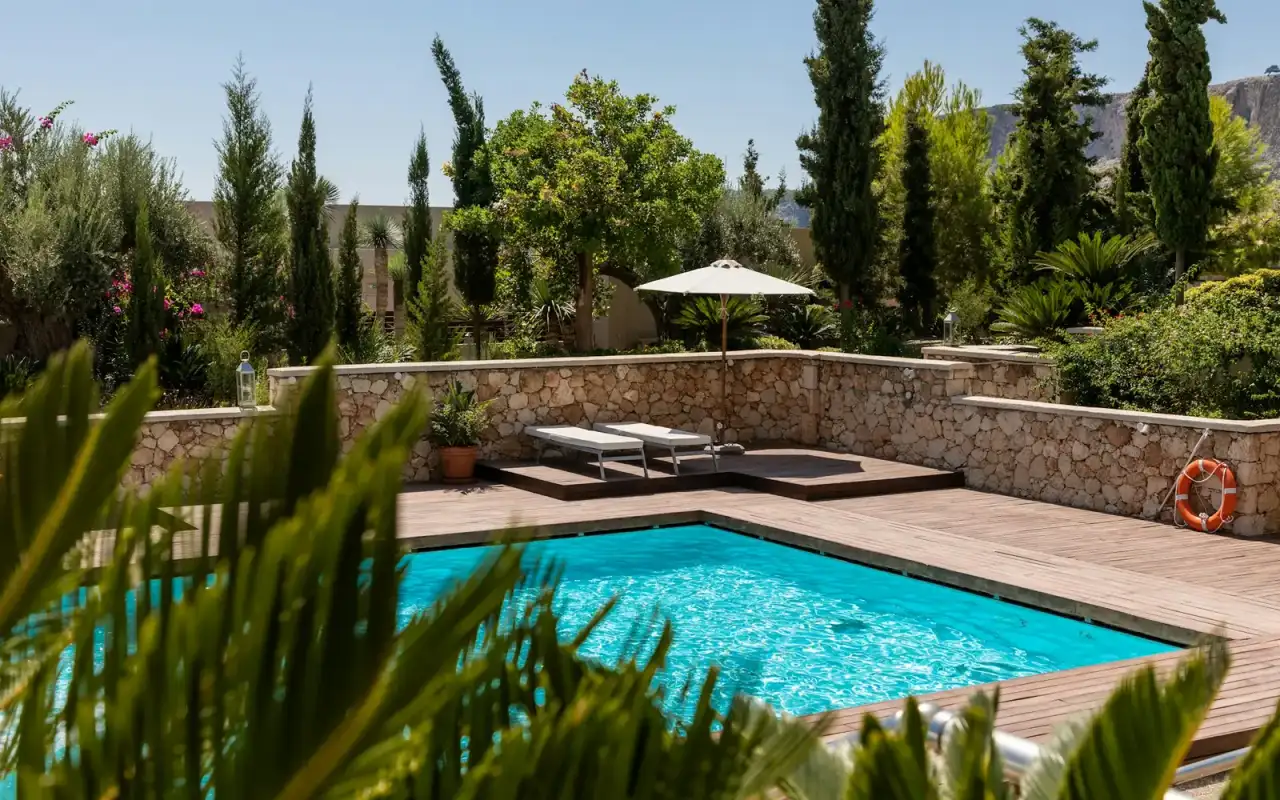
A seat wall that does not hold soil can still need a footing, and it can still be inside an association's appearance rules. It is not automatically R404.4. A fire pit is not a retaining wall unless it is also holding a bank. We are not publishing a per-foot price for either one. No public source we will cite gave a Volusia wall price as of November 1, 2026. Ask for caps, steps, and lighting as separate lines. The patio cost guide already refuses to invent that number. The quote checklist is where the wall becomes its own line beside the pavers.
Drainage behind a tall wall is an engineering detail, not a sentence we are promoting as code. R404.4 names water uplift as something the design must resist. It does not specify a gravel chimney, a pipe diameter, or a daylight outlet. Those belong on the sealed drawing if the section applies. A wall that holds water like a dam is a failure mode installers talk about. It is not, on this page, a homemade detail you should build from a paragraph.
Checklist before the block is ordered
- Measure the unbalanced fill, not just the block you can see above the low side.
- Say whether a drive, a pool, or a slope loads the high side. That is the 24-inch question.
- If the wall is over the 48-inch trigger and not supported at the top, budget a Florida engineer. The safety factor in the section is 1.5.
- Ask the city or county whether a permit is required even when the wall is shorter. Do not rely on the old training PDF alone.
- Keep foundation walls that hold the house on the house permit. R404.4 says it does not apply to them.
- If an association reviews exterior work, use the HOA checklist. Engineering does not replace that letter.
- Use the calculator for the patio area only. It does not price walls.
What this page will not guess
Last checked November 1, 2026. No Volusia fee, no local height amendment, and no segmental-block brand detail is published here. Daytona Pavers does not stamp drawings and does not build walls. If the project is only a low seat wall with level ground on both sides, say that on the form so the installer does not arrive expecting a hillside.
Last updated November 1, 2026.
Sources
- 2023 Florida Building Code, Residential, 8th edition, section R404.4, as displayed on UpCodes
- Florida Building Commission education packet quoting an older Building code section 105.2 exemption list (not an 8th-edition adoption text)
- City of Lake Helen, permits, building forms, and codes
Last checked November 1, 2026. Ranges are national or publisher typical figures, not quotes.
Keep planning
- Cost calculator Turn a square footage into a sourced band.
-
- Volusia County Every city, service, and guide.
-
-
-
Questions homeowners ask
When does a retaining wall need an engineer in Florida?
Under 2023 Florida Residential Code R404.4, when it is not supported at the top and retains more than 48 inches of unbalanced fill, or when it is over 24 inches and resists lateral loads besides soil. The safety factor stated there is 1.5. Last checked November 1, 2026.
Are walls under 4 feet exempt from a permit?
An older training PDF quotes that kind of exemption. We did not confirm it in the 8th edition text Volusia uses. Ask the building official. Do not treat this page as a permit waiver.
Does the rule apply to a seat wall?
Only if the seat wall is actually retaining unbalanced fill or extra lateral load. A low wall on flat ground is a different question. Ask before you assume it is exempt.
Does R404.4 cover the foundation of the house?
The section says it shall not apply to foundation walls supporting buildings. Those walls follow the foundation sections.
How much does a retaining wall cost in Volusia?
We are not publishing a price. No sourced local figure was found. Ask for engineering, drainage, and caps as separate lines.
Can you match an installer for a wall?
Yes, for a straightforward seat wall or low wall. Choose retaining wall or fire pit on the form. We do not provide the engineering R404.4 requires.
Request a quote after you have a range in mind
Daytona Pavers is a free service that connects homeowners with local, independent paver installers. It is not itself the contractor. Your request is shared with a local installer so they can contact you with a quote.
Tell us about the project. We pass the request to a local, independent installer. You do not pay Daytona Pavers for the introduction, and you decide whether to hire anyone.
A budget range is optional. It is a planning hint, not a promise. Read how we handle this information on the privacy page.